
Grease build-up calculator
Kitchen extract grease build-up calculator
Put in your own readings and see how fast grease builds up in a system, and roughly when it will reach 200 microns. A quick check on whether a kitchen is being cleaned often enough.
Use the calculatorTalk it through first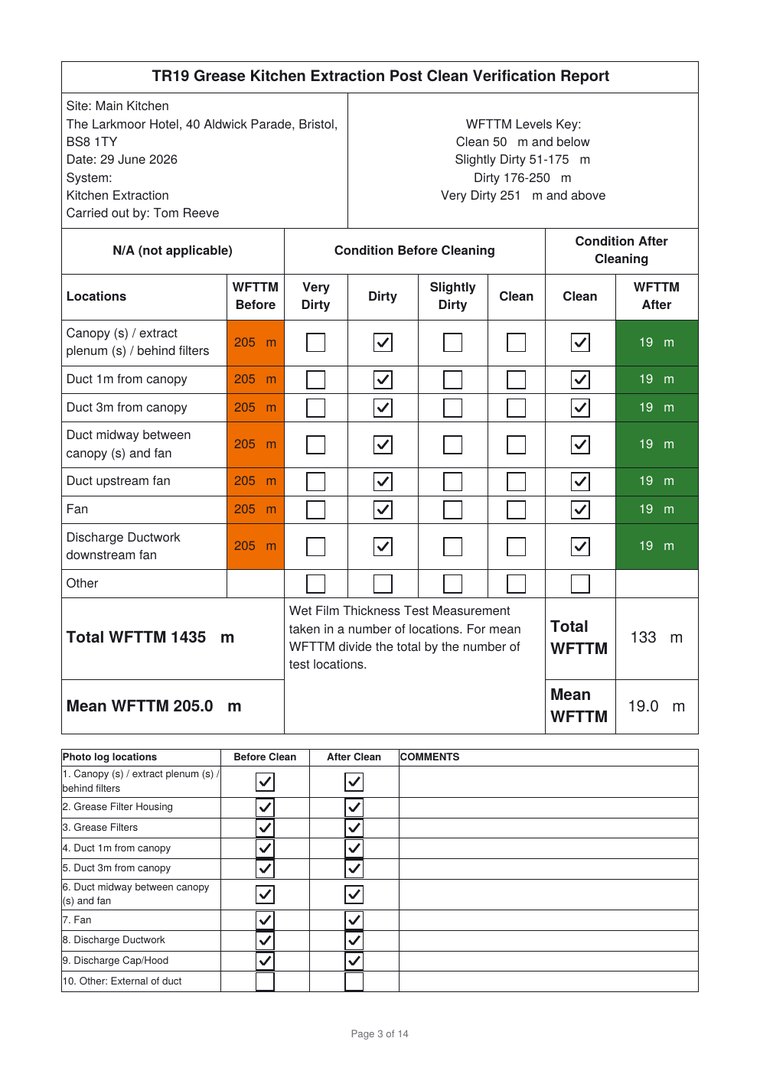
£90 a month
Flat, for the whole firm
Unlimited users
Office and engineers
No setup fee
No minimum term
Live demo
No sign-up needed
From your readings
How fast is grease building up?
Everything happens on this page - nothing is sent anywhere.
This is a guide to build-up, not a cleaning frequency. The frequency on a certificate is the determination of a competent person using the specification, who may vary it for the system in front of them.
Why it matters
The two numbers that count
Kitchens grease up at very different rates. Menu, hours, filters and how the canopy is used all change it, so a fixed interval can leave one kitchen overdue and another cleaned too often.
Measured readings tell you which. If a system is already over 200 microns when you arrive, the interval is too long - and the report is where that shows.
200 microns
Grease deposits should stay below this mean between cleans.
500 microns
Any area at or above this needs attention straight away.
Source: BESA's own guidance on cleaning kitchen extract systems.
In the app
Worked out on every job
- The mean deposit comes straight from the readings at each access point
- The certificate prints the result and the next clean date
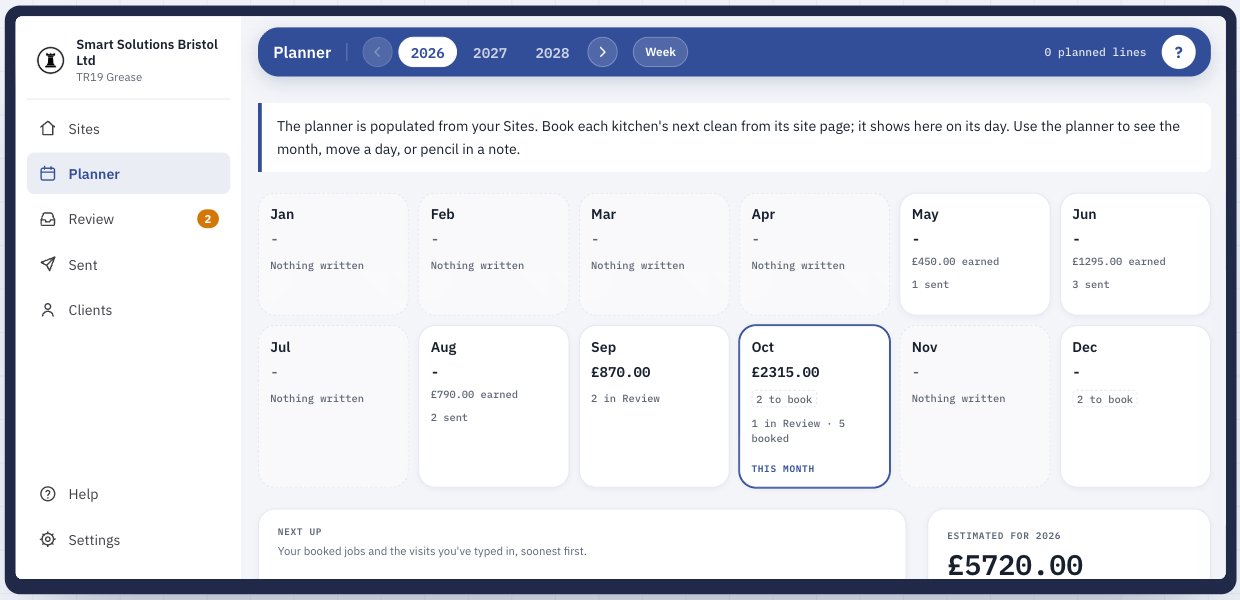
- The next clean waits on the planner for the office to book
See it on a real document: the sample certificate.
What it costs
£90
a month, flat, for the whole firm. Prices exclude VAT.
Open the live demo - no sign-up- Reports, certificates, planner and Xero invoicing included
- Unlimited users - the price stays the same as you grow
- No setup fee and no minimum term
- Your own private database - never shared with another firm
- Paid monthly by Direct Debit
Questions
Questions firms ask
How is this different from the frequency on a certificate?
The cleaning frequency on a certificate is set by a competent person using the specification, and may be varied for the system in front of them. This calculator only shows when your own measured build-up would reach the 200 micron level, as a check on whether the current interval is about right.
Where does the 200 micron figure come from?
BESA's guidance says grease deposits should stay below a mean of 200 microns between cleans, and that any area at 500 microns or more needs attention straight away.
What readings should I use?
The mean of the deposit readings before cleaning, and, if you have it, the mean left after the previous clean. Wet film thickness or deposit thickness tests both give microns.
Does the app do this on every job?
Yes. The mean deposit comes straight from the readings at each access point, and the next clean date follows on the planner. See kitchen extract cleaning scheduling.
Is our data kept separate from other firms?
Yes. Every firm gets its own database, set up for that firm alone. No database is shared, so your clients, sites, reports and photographs never sit alongside another firm's records.
Is it approved by BESA?
No. TR19 Grease is BESA's specification, and the software produces reports laid out to follow it. Smart Solutions is not affiliated with BESA and is not endorsed by it.
Let the app do the sums on every job
Open the live demo and see the readings, the mean and the next clean date on a real job. No sign-up, no sales call.
Open the live demoBook a callTR19® is a registered trade mark of the Building Engineering Services Association (BESA). Smart Solutions Bristol Ltd is not affiliated with or endorsed by BESA.