
What a fire damper app should do on the engineer's phone
A damper test nobody can find did not happen.
Most fire damper apps are judged in the office, on how the certificate looks. The real test is on site: a ceiling void, a riser cupboard, sixty dampers on the list and a client who wants the paperwork today. Here is what an app has to get right on the engineer's phone - and what it should never do.
Edward Bristow3 November 20263 min read
Why the record matters as much as the test
The Regulatory Reform (Fire Safety) Order 2005, Article 17, puts the duty on the responsible person to keep fire safety equipment - fire dampers included - maintained in efficient working order. Scotland and Northern Ireland have their own regulations to the same end.
BESA says dampers should be tested at least annually under BS 9999, by a competent person, with accurate and verifiable records and a full asset register showing where each damper is and what condition it is in (BESA, 24 June 2026).
So the app is not a nice-to-have. It is where the proof lives.
Six things a fire damper app should do on site
- Start from the register. The engineer should open the site and see every damper on it - location, reference, type - imported once from the client's spreadsheet, not typed again on site.
- Give each damper its own due date. Sites are rarely tested in one visit. Each damper should carry its own date, so the planner shows exactly which ones are due, overdue or waiting for a retest.
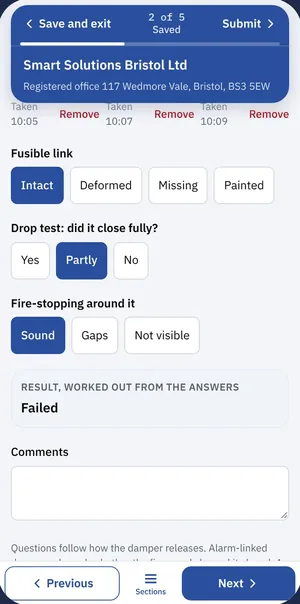
- Work the result out, not pick it. The engineer records what happened - the damper closed, or it did not - with photos. The pass or fail should follow from what was recorded, never be chosen from a list.
- Retest only the dampers that failed. When three dampers fail, the retest should cover those three, and move only their dates. Retesting the whole site to clear three dampers wastes a day and muddies the record.
- Keep inspections and tests apart. A visual inspection between tests is useful - it can bring a test forward. It should never clear a test, and no certificate should follow an inspection.
- Send the paperwork the same day. Once the office has reviewed the job, the client should get a locked certificate (Satisfactory or Unsatisfactory), the test report and a location plan with damper dots - with the legal line for the site's nation. What was emailed is what is stored; a correction re-issues as Rev B, with the original kept.
What it should never do
- Claim the work meets a standard. The standard is met by the testing your engineers do; the app records it.
- Let a damper drop off the list. If it is not on the register, it does not get tested.
- Turn a failed damper into a pass by editing a sent certificate.
How SMART Reports handles it
SMART Reports is fire damper testing software built around those six points: the register imported from a spreadsheet, each damper with its own due date, retests that move only the dampers retested, inspections included at no extra cost, and the certificate, test report and location plan sent from the office the same day. Every engineer and office user is included in £90 a month - £150 for any two report types, £200 for all three. No VAT charged.
For what the record itself should hold, read What a fire damper test record should show and The fire damper register explained. To keep the whole register in one place, see our fire damper register software.
Read next
- Fire damper testing and inspections
- Fire damper register software
- A failed fire damper: what happens next
Sources
- Regulatory Reform (Fire Safety) Order 2005, Article 17 - legislation.gov.uk, read 3 November 2026
- BESA, "Damper training is vital part of safety culture" - 24 June 2026, read 3 November 2026