
The report is written on site, or it is written at 10pm.
Most kitchen extract cleaning firms already know what a good post-clean report looks like. The London Fire Brigade's guidance note GN86 sets it out: what was cleaned, the readings before and after, photos, and every part of the system that could not be reached, with the reason. The hard part is not knowing what goes in the report. It is getting it all down while the engineer is still standing under the canopy.
That is the job of a TR19 Grease app. Here is what it should do on the engineer's phone - and what to check before you pay for one.
1. The readings decide the pass, not the engineer
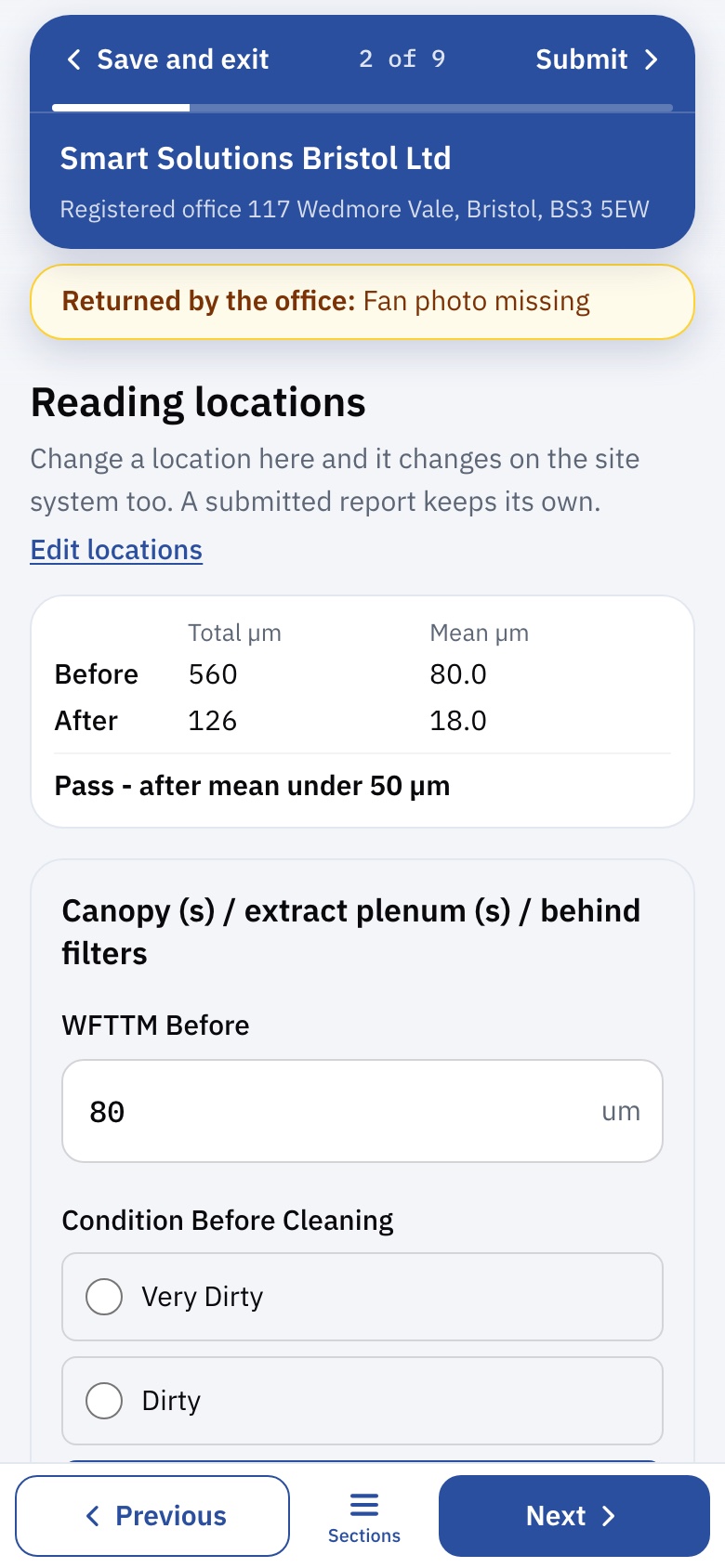
TR19 Grease sets two marks: a mean of 200 µm means a clean is due, and after the clean the mean must come down to the post-clean level - under 50 µm on the screen below. The app should take each wet film reading, work out the mean, and show pass or fail. If the engineer picks "pass" from a list, the report is only as good as their memory. If the readings decide it, the report can be checked.
2. Photos tied to the place they were taken
Before-and-after photos are the proof a client and an insurer look for. They should sit against the canopy, riser or fan they show - not in a camera roll to be sorted later.
3. Areas not done, with the reason
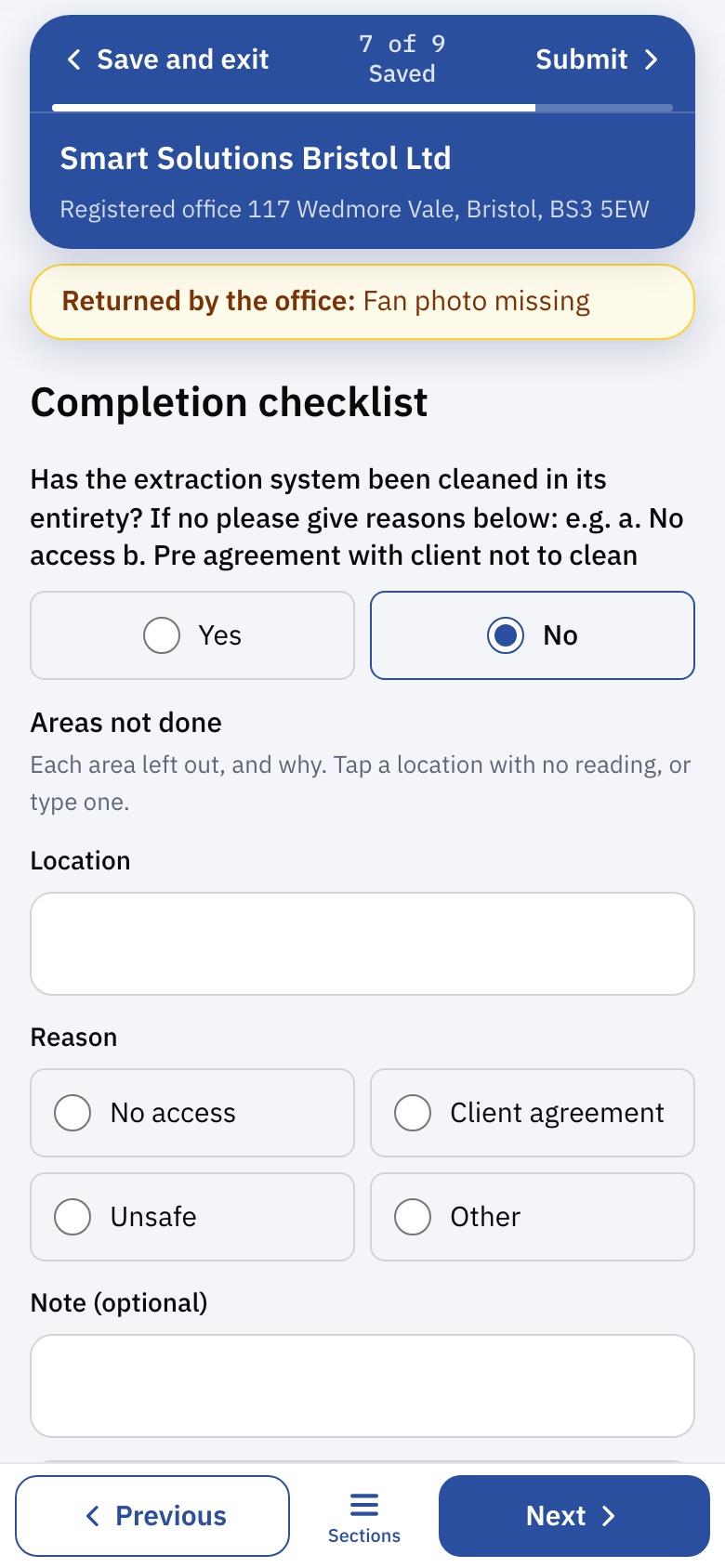
GN86 is clear that parts of a system that were not cleaned must be listed, with why: no access panel, locked plant room, ductwork boxed in. An app should make this a required tap, not an optional note. A report that leaves it out reads as if everything was cleaned.
4. Remedials recorded on the spot
Missing access panels and damaged filters are found on site. Record them there, so the office can quote for them the same week.
5. The next clean date works itself out
How often a kitchen is cleaned depends on how hard it is used. The app should set the next date from the kitchen's use, so the office is not working it out by hand and the planner shows what is due before it is overdue.
6. A locked report sent the same day
When the engineer finishes, the office reviews the report, sends it back if something is missing, and sends it to the client the same day. Once sent, it should be locked: what was emailed is what is stored. A correction should go out as a new revision, with the original kept.
One thing to check before you buy
Ask what happens with no signal. Plant rooms and basements often have none. In SMART Reports the engineer opens the job while there is still signal. Ask any supplier the same question and test it yourself.
See it on a phone
The live demo shows a sample firm with fictional sites. Open it on your phone and work through a grease job from readings to sent report - no sign-up needed. For how the post-clean report itself is put together, see our guide to TR19 cleaning software, or the overview of kitchen extract cleaning software.
SMART Reports covers TR19 Grease and fire damper testing and inspections, with TR19 Air coming soon.
TR19® is a registered trade mark of the Building Engineering Services Association (BESA). Smart Solutions Bristol Ltd is not affiliated with or endorsed by BESA.